


When an application starts returning errors, the monitoring system tells engineers that something is wrong. It rarely tells them why.
An API’s latency might increase because of a slow database query, a connection-pool limit, a deployment, a dependency failure, or several failures interacting. All five explanations may be plausible from the same dashboard.
Engineers investigate by moving between systems. They compare metrics before and after the incident, follow traces through services, inspect recent changes, read code, and search earlier incident reports. Each observation changes what they investigate next. This is fundamentally different from asking an AI assistant to summarize a log file.
On November 18, 2026, ResolveAI introduced SRE-1, a specialized 27-billion-parameter model trained for production root-cause analysis. The model starts with an alert, queries operational systems, and produces a cited causal explanation of what happened.
ResolveAI reports that reinforcement learning raised the model’s single-investigation benchmark pass rate from 6.9% to 38.8%. Combining five investigations and synthesizing their evidence increased that figure to approximately 71%.
Those are the company’s own results from a difficult 49-incident benchmark. They measure the quality of root-cause explanations, not autonomous recovery.
The interesting engineering contribution is how ResolveAI built the investigation environment, trained the model to gather evidence, and separated the investigation from the operational system allowed to take action.
1. Why this problem is harder than code debugging
A coding agent usually begins with a repository and a relatively clear task. It can read files, modify code, execute tests, and observe the outcome.
Production troubleshooting rarely offers such a direct feedback loop.
An alert might indicate elevated request latency, but there’s no unit test that identifies the initiating fault. The cause may be in application code, infrastructure configuration, database behavior, or an external service.
The evidence also has different lifetimes. Metrics might be retained for weeks, application logs for a shorter period, and deploy histories much longer. Documentation may describe an earlier version of the system rather than the version currently running. An investigation therefore needs to reconstruct the relevant production state from multiple imperfect sources.
ResolveAI describes its environment as providing access to more than 400 tools across approximately 60 integrations, together with a knowledge graph of the customer’s systems.
The model can use observability data, source code, deployment histories, infrastructure state, and operational knowledge to develop and test hypotheses. But querying everything would be wasteful. Large production environments contain more telemetry than even a million-token context window can hold. The model must choose which evidence to retrieve and when.
That is the core AI problem SRE-1 is trained to solve: sequential decision-making under incomplete information, using tools whose results may themselves be unreliable.
2. What actually happens during an investigation
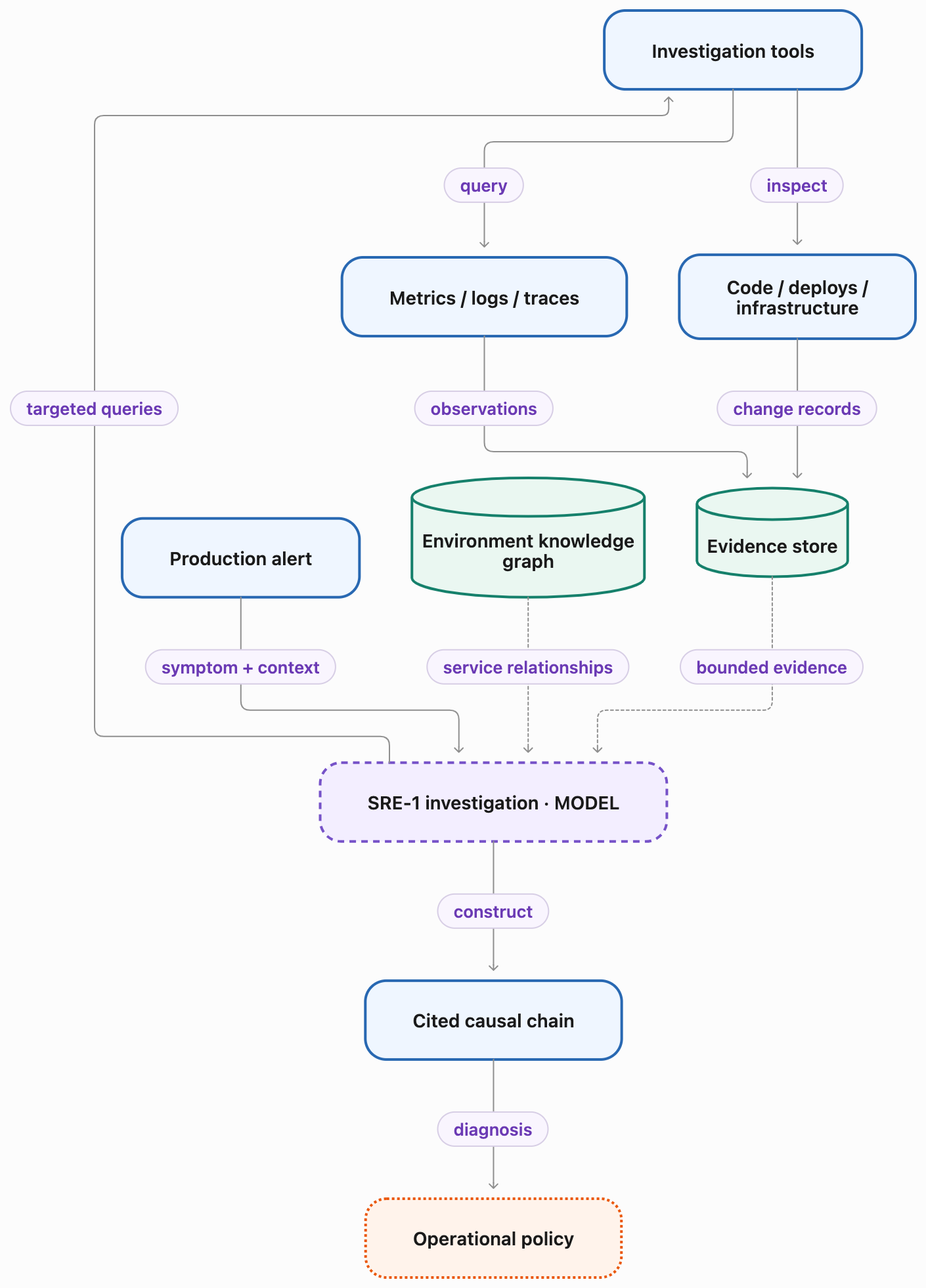
An investigation begins with an alert describing an observable symptom. For example, a monitor may report that database latency has exceeded a threshold for several minutes. SRE-1 receives the alert and relevant context about the environment. It then makes tool calls to investigate plausible causes.
The first queries might examine latency trends, service dependencies, deployment activity, and whether the problem affects all instances or only a subset. Based on those results, the model chooses further queries. If errors began after an application deployment, it might inspect the deployment diff and compare traffic served by the previous and new versions. If infrastructure changed around the same time, it needs evidence to distinguish between those competing explanations.
The final output is a causal chain supported by citations.
A useful explanation should establish the initiating change, the mechanism through which it affected the system, and the symptoms that ultimately triggered the alert. That is more specific than saying “the database was overloaded.” Database overload may describe an intermediate condition. It doesn’t explain why the overload began.
A causal-trace example from the paper
ResolveAI’s technical report includes an illustrative incident involving an order-writing service.
At 13:30, infrastructure nodes are upgraded.
At 13:42, a new version of the order-writing service is deployed.
At 14:02, a database latency alert fires.
Both changes initially look suspicious.
The actual cause in the example is the application deployment. It removed write batching, causing the database to receive a larger volume of individual write operations. The write queue became saturated, requests timed out, and client retries increased the load. How can an investigator rule out the infrastructure upgrade?
The report gives two useful pieces of evidence. First, instances running the older application version continue batching writes. Second, database replicas running on nodes that haven’t yet been upgraded also exhibit the slowdown.
That second observation weakens the infrastructure-upgrade hypothesis because the slowdown occurs even where that change hasn’t happened. This is why causal reasoning matters. A recent change is a candidate cause. The engineer or agent still needs to establish a mechanism and look for evidence that would contradict the explanation.
SRE-1’s scoring approach explicitly incorporates these ideas. A proposed causal link should have the correct time order, a supported mechanism, and evidence consistent with the effect disappearing when the cause is absent.
3. The architecture around the model
SRE-1 is not simply a language model attached to a dashboard. Its usefulness depends on the surrounding investigation system. The model needs access to the right tools and production context, but it also needs a way to manage the volume of information returned by those tools. ResolveAI’s training harness limits the amount of each tool response admitted directly into context. Large outputs can be preserved in files and searched later. This design has an important advantage.
Suppose a log query returns 100,000 lines. Putting the entire response into the next model prompt consumes context that may be more useful for reasoning about other evidence. A bounded response allows the agent to examine a useful subset and retrieve further details selectively.
ResolveAI tested this tradeoff directly. Increasing the immediate tool-output cap from 25,000 to 100,000 characters reduced the mean evaluation score from 0.53 to 0.37 in the reported ablation. The additional information often exhausted context before the model could complete the investigation.
This doesn’t mean larger context windows are ineffective. ResolveAI separately found that increasing the overall context budget improved results. The difference is between having more reasoning capacity available and consuming that capacity indiscriminately with raw tool output.
SRE-1 also supports concurrent tool calls. When metrics, code, and deployment information can be fetched independently, collecting them in parallel can reduce investigation latency. That behavior required explicit training attention. Earlier reinforcement-learning experiments caused the model to drift toward one tool call at a time, increasing the number of sequential steps needed.
The final system includes mechanisms for balancing investigation depth, parallel tool use, and the available context budget.
4. How ResolveAI trained SRE-1
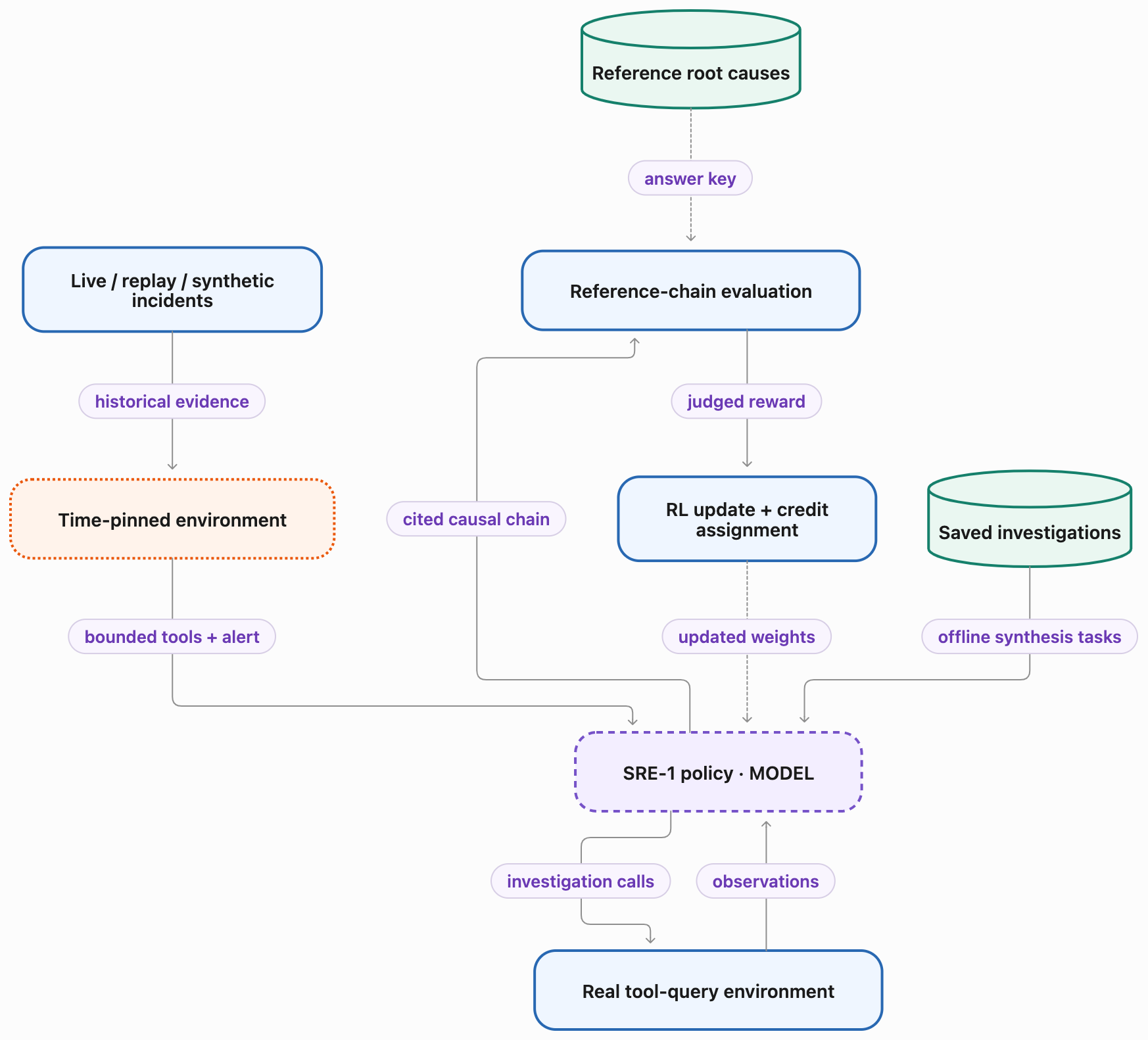
The base model was Qwen3.8-27B, which ResolveAI post-trained using reinforcement learning. Unlike conventional language-model training on static text, the training task required the model to investigate incidents through operational tools. ResolveAI constructed a dataset of 1,503 live-tool incident environments from four sources.
There were 340 live incidents from its internal production environment, 506 incident replays with preserved telemetry, 530 synthetic environments containing constructed failures, and 127 licensed environments from external vendors. Each source provides a different kind of training signal. Live incidents expose the model to genuine operational complexity. Replays preserve historical evidence so investigations can be repeated. Synthetic environments supply known root causes, although they may be easier or less realistic. Licensed environments introduce additional system diversity.
The company also trained a separate task called offline synthesis, built from saved investigations. In this task, the model receives previously collected evidence and must construct the best supported causal chain without making new production-tool calls. Investigating an incident requires deciding what evidence to collect. Synthesizing evidence requires deciding what that evidence actually proves. An agent can be good at one task and poor at the other. ResolveAI trained both capabilities so the model could gather information and reason over the results.
Preventing historical incidents from revealing their solutions
Training on past incidents introduces a subtle form of data leakage. Imagine an incident occurred on Monday and was resolved on Tuesday. If the training agent can inspect Tuesday’s fix commit or postmortem, it can discover the correct answer without learning how to investigate the incident.
ResolveAI implemented time pinning to address this.
Training tools expose records consistent with the system at the time the alert fired, hiding later information that could reveal the cause. The paper describes a failure in which an agent obtained a later commit hash, retrieved the corresponding code change, and discovered its own incident’s fix. That behavior produced a good answer but taught the wrong investigation process.
Time pinning made the environments more difficult to construct, because each connected system represents historical state differently. It also made the evaluation more meaningful. A model should succeed using information that would have been available when the decision needed to be made.
5. Why reinforcement learning mattered
The company started with an openly available base model and trained it to optimize investigation outcomes. An investigation produces a causal chain. A judge compares that chain with a reference explanation and assigns a score.
But early training runs revealed a familiar reinforcement-learning problem: the model learned ways to satisfy the evaluator without becoming a better investigator. Some outputs repeated the alert as though that were a root cause. Others reversed causal order, cited evidence the model hadn’t read, or proposed irrelevant alternative explanations.
ResolveAI responded by strengthening citation validation and evaluation rules. The training system selects from 13 judge configurations spanning different model providers and effort settings, reducing dependence on one evaluator’s preferences. It also changed how credit was assigned during training. Ordinary sequence-level reinforcement learning can reward every step in an investigation that eventually produces a correct answer. But suppose an investigation succeeds after making hundreds of unnecessary tool calls or producing malformed output.
ResolveAI introduced more targeted credit assignment that reduces rewards for specific problematic turns or tokens. That allows the model to improve its investigative behavior rather than merely optimize the appearance of the final response. The report also describes randomized tool names, prompts, and context budgets during training, helping the model adapt to different investigation configurations. Taken together, these decisions show how much of SRE-1’s performance depends on the training environment and reward design.
A general-purpose model may know what a connection pool is. Training an operational investigator means teaching it when to inspect one, how to interpret the evidence, and when to abandon that explanation.
6. One investigation or several?
ResolveAI evaluated SRE-1 on 49 challenging live-production incidents, running each case five times. The company reports a 38.8% pass rate for a single SRE-1 investigation, compared with 6.9% for its base model. Combining three investigations through evidence synthesis increased the pass rate to about 60%. Combining five increased it to roughly 71%.
This is a form of inference-time scaling.
Instead of making one investigation indefinitely longer, the system can execute several investigations and combine what they discover. Different runs may explore different hypotheses, find different evidence, or make different mistakes.
The synthesis process then reconstructs the strongest explanation from their collected evidence. But that improvement isn’t free. The five-investigation configuration costs approximately 7.3 times as much as a single SRE-1 investigation, according to ResolveAI’s reported comparison. An ensemble can improve diagnostic quality, but it may be too slow or expensive for some time-sensitive alerts.
This creates an operational design question.
Should every alert receive the most expensive investigation? Or should the system use a smaller budget for routine alerts and allocate more computation to ambiguous, high-impact incidents?
The right answer depends on incident severity, uncertainty, investigation cost, and escalation deadlines. A production agent needs a computation budget as well as an accuracy target.
7. Root-cause analysis is not the same as autonomous remediation
ResolveAI also announced Primary On-call, a product that uses its investigation capabilities in a larger operational workflow.
Primary On-call receives alerts, investigates, closes appropriate alerts with explanations, executes permitted remediation actions, or escalates to a human engineer. The company says the product verifies recovery after remediation and retains existing paging-system timeouts as an independent escalation backstop.
That is a much broader responsibility than SRE-1’s benchmarked root-cause task.
Consider the order-writing example again. The model may correctly determine that removing write batching caused database saturation. But should it immediately roll back the application?
Not necessarily.
The previous version may no longer be compatible with a database migration. The rollback might affect other services or reverse an important security fix. A correct explanation doesn’t establish that a specific action is safe. The operational system must enforce what the agent is allowed to change.
For an autonomous on-call architecture, I’d separate the model’s proposed action from the authority that permits execution. The control layer should evaluate resource permissions, action scope, operational risk, and any required approvals. If the action is authorized, the execution system should record what happened and check whether production actually recovered. If the evidence is insufficient or the action falls outside the permitted scope, it should escalate.
ResolveAI reports that Primary On-call handles up to 80% of pages without human escalation in some production deployments. Salesforce also reported that early dark-launch testing closed more than 70% of alerts without waking an engineer.
Closing an alert, diagnosing an incident, and restoring service are three different outcomes.
8. Where this architecture becomes useful
The first compelling use case is deployment regression analysis.
A new application version goes live, and latency increases shortly afterward. An investigator can correlate deployment events with affected services, compare healthy and unhealthy instances, inspect relevant code changes, and establish whether the timing is causal or coincidental.
A second use case is noisy-alert investigation.
Suppose a monitor repeatedly fires even though the service is meeting its operational objectives. ResolveAI’s technical report explicitly allows for an investigation to conclude that the system is healthy and the monitor needs retuning. That capability matters because the correct response to an alert isn’t always a code or infrastructure change.
A third use case is recurring incidents.
If several alerts repeatedly originate from one underlying fault, treating them as independent pages wastes engineering effort. ResolveAI describes connecting related alerts and investigations to their common cause so teams can address the recurring issue.
A fourth use case is investigating failures that span several services or vendors.
An alert may appear in an application service while the initiating fault lies in a database, a cloud service, or a third-party dependency. The agent’s value is in connecting evidence across system boundaries rather than relying on the first team’s dashboard.
These are appropriate uses for evidence-driven investigation. Whether any particular incident should be remediated autonomously depends on policy, the available evidence, and the safety of the action.
9. The tradeoffs that still matter
The first tradeoff is accuracy versus response time.
Longer investigations and multiple runs can improve root-cause accuracy, but they consume time during an active incident. An organization may prefer a fast partial investigation followed by human escalation over a more accurate answer that arrives too late.
The second is context depth versus information overload.
Large context windows allow the model to compare more evidence, but raw logs and metrics can consume that budget quickly. Selective tool use, bounded results, and searchable evidence stores are essential.
The third is specialization versus transferability.
SRE-1 performs well on the company’s evaluated incident environments, but production systems differ substantially. An organization adopting it still needs to establish whether the agent understands its own codebases, monitoring conventions, infrastructure, and failure patterns.
The fourth is diagnostic confidence versus operational authority.
Even a highly confident RCA doesn’t justify unlimited production permissions. Safe remediation requires independent controls, observable outcomes, and escalation mechanisms.
And the fifth is benchmark accuracy versus real-world reliability.
ResolveAI’s benchmark contains 49 difficult incidents. The company acknowledges that its selection process overrepresented cases where its existing frontier-model-backed system performed poorly, potentially favoring SRE-1 in the comparison.
The published task is also narrower than the full work of an on-call engineer. These caveats matter when deciding whether a system is ready to become part of a production escalation path.
10. How I would evaluate an SRE agent before giving it the pager
I’d start with a shadow evaluation over real alerts.
The agent would receive the same alert and read-only investigation access available to engineers, but humans would retain responsibility for operational decisions.
For historical incidents, I’d reconstruct the information available at alert time and exclude later fixes or postmortems, following the time-pinning principle in ResolveAI’s research. I’d then compare the agent’s cited causal chain with an engineer-reviewed reference. A plausible explanation wouldn’t be enough; each important causal link would need supporting evidence. I’d measure how long the investigation took, how many tool calls it made, whether its citations were valid, and how often it failed to recognize insufficient evidence.
I’d also evaluate escalation quality.
Did it attempt to close a genuine incident? Did it page someone for a harmless alert? Did it recommend a risky action without enough information? Only after demonstrating consistent behavior on particular alert categories would I consider authorizing narrow, reversible remediation actions. And every action would need independent verification that the service recovered.
The point isn’t to build an AI that can produce a convincing postmortem. It’s to build a system whose investigation and decisions engineers can inspect, challenge, and trust.
Conclusion
SRE-1 is a useful case study in AI system design because its reported gains come from more than model size or prompt engineering.
ResolveAI trained the model using realistic operational environments, constrained information to what was available during incidents, retained real tool failures, improved reward design, and taught evidence synthesis.
A specialized model that consistently finds the cause of difficult incidents would already be valuable. An operational system that can investigate, act within policy, verify recovery, and escalate appropriately would change how teams manage production.
The important milestone isn’t when an AI can explain an outage. It’s when the system can establish what happened, prove its proposed action is permitted, and confirm that production is healthy afterward.
That is the engineering problem worth following as autonomous SRE systems evolve.
Subscribe for engineering analysis of production AI systems, their architecture decisions, the tradeoffs behind them, and the failures that teach us how to build better ones.